
Maryland Native Plant- Mayapple
Article and Photos by Kyla Kroh
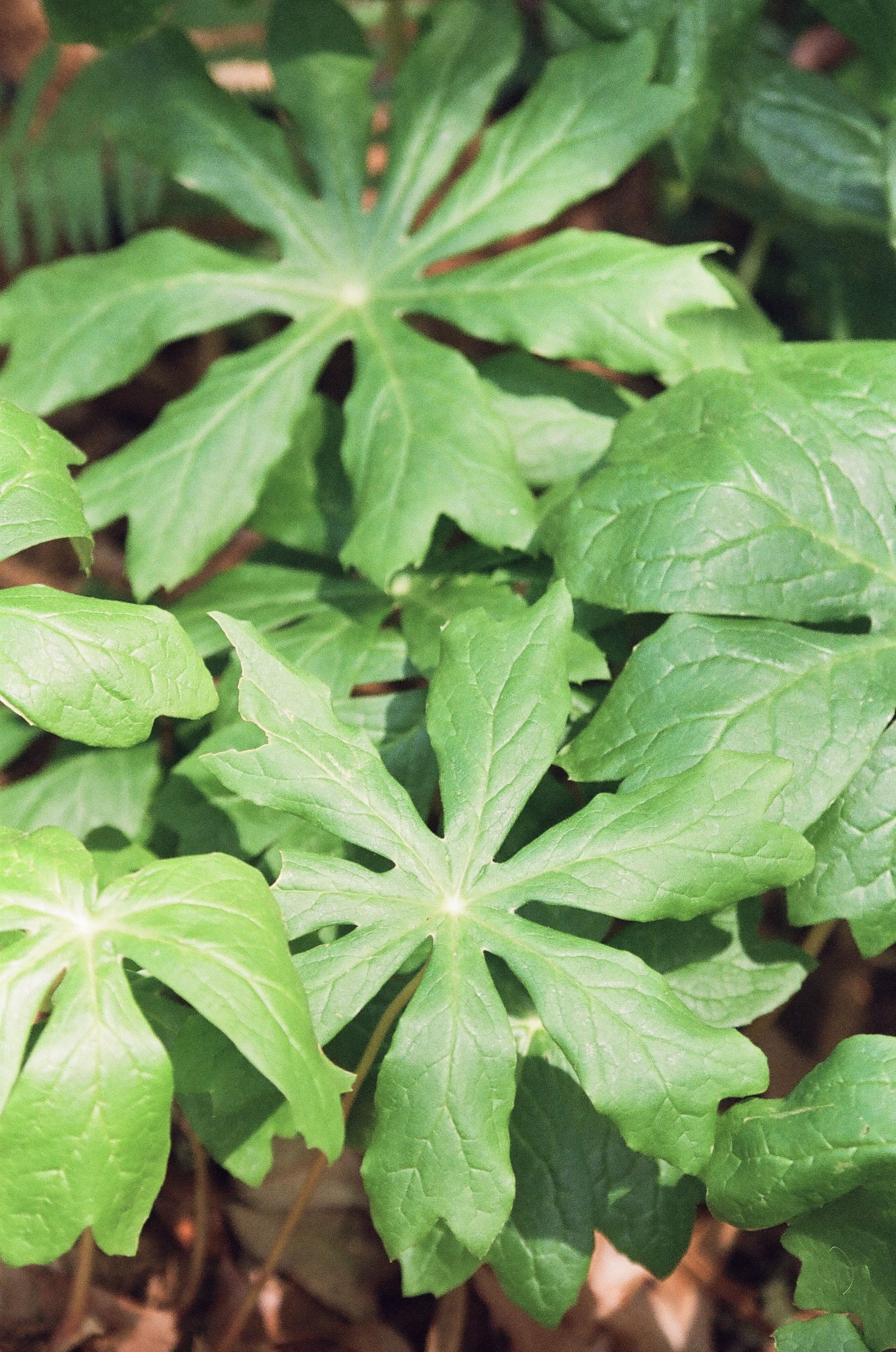
If you’ve been looking for a reason to get on your hands and knees and look at the underside of plants, here’s one you won't want to miss! Mayapple (Podophyllum peltatum) is a herbaceous perennial in the Berberidaceae family and can be found across eastern North America.
Habitat and Distribution
Mayapples require moist, shady woodland habitat to thrive. They have a unique leaf shape that conspicuously hides their whitish, sometimes pink flowers. You won’t find its nodding flowers on every plant, though. Interestingly enough, they’re only found on plants with two leaves. Look under the leaves in the V where the leaf stalks (petioles) split above the stem, and you’ll find a solitary dangling flower.
As the name suggests, Mayapples bloom in May, and the flowers are pollinated in spring by native long-tongued bees. Bumblebees (Bombus spp.), particularly the solitary queens in early spring, are common pollinators of Mayapple flowers. In summer, cross-pollinated Mayapple flowers produce a large yellow berry. The aroma of the fruit is attractive to wildlife, particularly eastern box turtles (Terrapene carolina). Cool fact! Box turtles are a primary seed disperser for the native mayapple.
Growing Mayapple at home!
Mayapple easily naturalizes in shaded areas and makes an excellent addition to a woodland garden. They are resistant to deer and rabbits. Mayapple thrives in rich soil, so adding organic leaf mulch or compost every fall can be extremely beneficial. The foliage dies back in late summer, and new growth appears the following spring. Companion planting with summer and fall blooming plants is recommended when the mayapple leaves die back.
Mayapple looks great planted with:
Wild Geranium (Geranium maculatum)
Jack-in-the-Pulpit (Arisaema triphyllum)
Wild Blue Phlox (Phlox divaricata)
Wild Ginger (Asarum canadensis)
White Wood Aster (Eurybia divaricata)
Ferns also add great texture and structure to the shade garden.
Caution: Mayapple seeds, flowers, leaves, and roots are poisonous to humans if ingested.